‘roscón de reyes’
The European tradition of hiding a bean in a cake on Epiphany and choosing a king for the day has been documented since the Middle Ages and has its roots in the ancient Roman Saturnalia, festivities held at the end of the year in honour of Saturn.
Before you start
Recipe cost: €40
Prep time: 8 hours over 2 days
Difficulty: medium
Ingredients
Diplomat cream
4 strips of lemon peel
4 vanilla pods
1 l whole milk
10 g gelatine leaves
250 g egg yolks (7–8 egg yolks)
130 g sugar mixed with
30 g vanilla sugar
40 g strong white bread flour (≥11% protein), such as Ariana
20 g cornflour
20 g crème caramel mix
80 g butter
30 g Vahiné® vanilla flavouring
260 g Central Lechera Asturiana whipping cream (38% fat)
Pre-ferment
350 g milk (120 + 150)
Peel of 2 oranges and 2 lemons
160 g strong white bread flour
28 g granulated sugar
12 g fresh yeast
Dough
24 g fresh yeast
550 g strong white bread flour
3 g salt
150 g sugar
100 g unsalted butter
40 g honey
14 g orange blossom water
10 g aged rum
2 eggs and 1 egg yolk (120 g)
Firm whipped cream
500 g Central Lechera Asturiana whipping cream (38% fat)
6 g unflavoured powdered gelatine
40 g milk (approximately)
64 g icing sugar mixed with
16 g vanilla sugar
Decoration
1 egg with 1 tbsp milk
Raw flaked almonds
Candied fruit
Sugar moistened with orange blossom water
Gift and bean
Equipment
Stand mixer
Thermometer
15 cm ∅ round bowl
Metal bowl for whipping the cream
Recipes consulted
Roscón by Loli Dominguez, La cocina de Loli Dominguez
Diplomat cream by Ettore Cioccia, Bavette-Gastronomia
Whipped cream by Anna Terés, Anna Recetas Fáciles
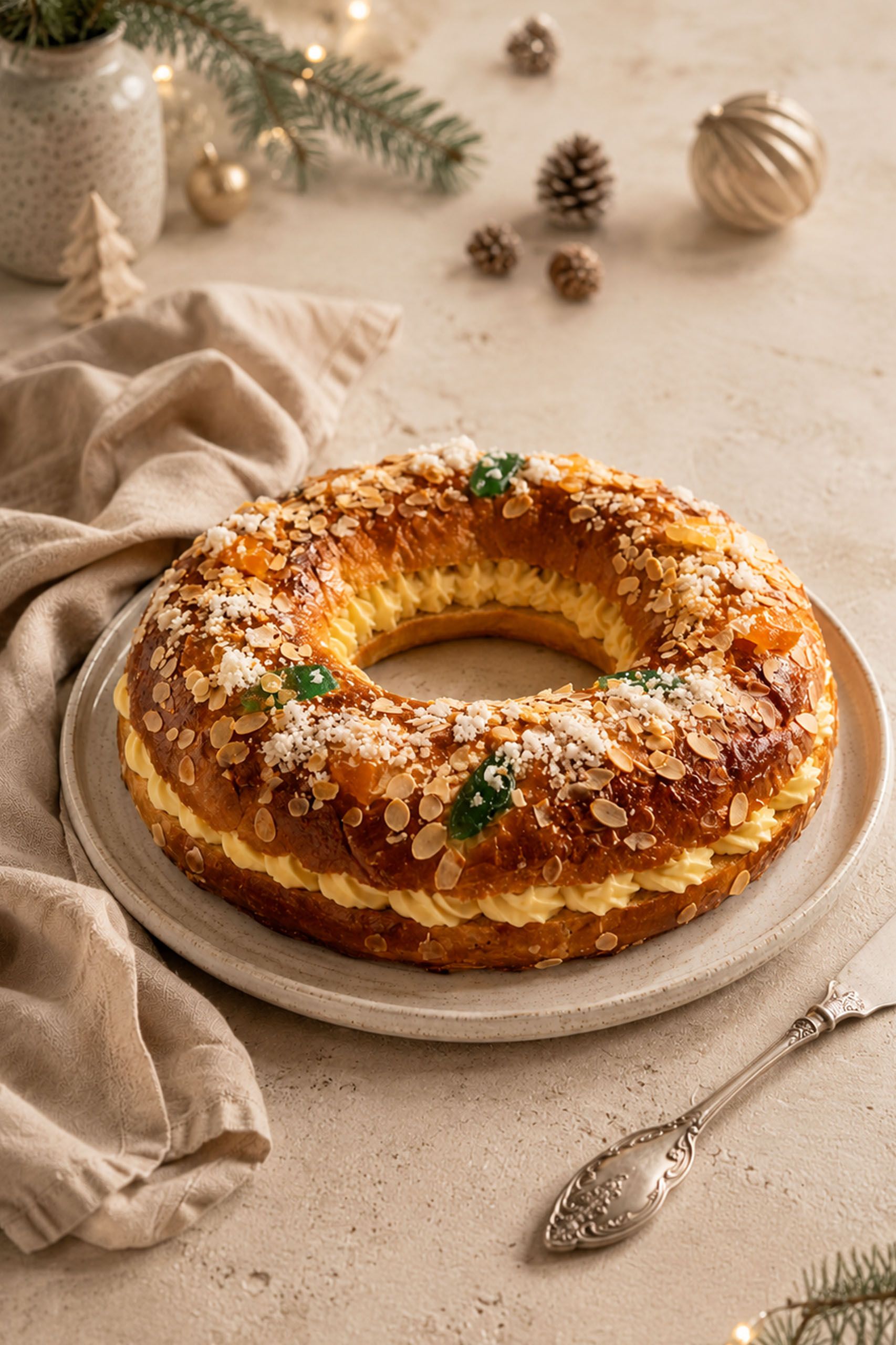
This recipe makes two three Kings’ cakes — roscones de reyes—, one filled with diplomat cream, which is a lighter pastry cream, and the other with whipped cream.
Day 1. 16:00: diplomat cream (Process time: 2 hours)
Diplomat cream is a combination of pastry cream and softly whipped cream. A similar pudding became popular in 1856 after Montmirel, the chef of a diplomat, first presented it at the Congress of Paris. This congress brought the Crimean War to an end. The two events don’t appear to be related.
- Place the equipment for whipping the cream in the freezer.
- Bring the milk to the boil with the lemon peel.
- Add the vanilla pods, split lengthways.
- Bring the milk to the boil, remove the lemon peel and leave the vanilla to infuse for 30 minutes.
- Strain the milk. Scrape out the seeds from the vanilla pods and add them to the milk.
- Fill a bowl with ice and water and leave for 5 minutes. Remove the ice, then soak the gelatine in the chilled water.
- Whisk the egg yolks and sugar vigorously until pale. Stop when the mixture reaches a light ribbon stage: when you lift the whisk, the batter falls in a thick trail that sits on the surface for a few seconds like a ribbon before sinking. The creamy texture makes it easier to incorporate the remaining dry ingredients.
- Add the sifted flour, cornflour and crème caramel powder all at once. Mix only until smooth and well combined. Do not whisk, as this would give the cream a pasty elasticity and make it stick to the palate.
- Pour the milk over the egg mixture, pass everything through a sieve back into the saucepan, then return to the heat and stir continuously with a French whisk for about 12 minutes.
- Bring to the boil, then immediately transfer to another container.
- Add the gelatine, patted dry with kitchen paper. Stir until dissolved.
- Add the butter. Stir until dissolved.
- Add the vanilla flavouring and mix.
- Refrigerate the cream covered with cling film in direct contact with the surface to prevent a skin forming.
- Whip the cream by hand until it forms soft peaks and has a light, moderately firm texture. Whisk slowly at first to build volume, then increase the speed halfway through.
- Add a generous spoonful of whipped cream to the pastry cream to lighten it. Gently fold in the remaining whipped cream.
- When ready to use, whisk with an electric whisk until it regains its creamy texture.
Keeps refrigerated for about 5 days. Do not freeze.
Day 1. 08:00: pre-ferment and making the dough (Process time: 2 hours)
Pre-ferment
- Bring 350 g milk to the boil with the lemon and orange peel. Cover the saucepan and leave to infuse for at least 25 minutes.
- Prepare the ingredients, including those for the dough.
- Strain 120 g milk and heat to 35°C (about 15 seconds in the microwave).
- Crumble the yeast into the milk and dissolve it with a whisk.
- Add the sugar. Mix.
- Add the sifted flour. Once incorporated, knead by hand for 5 minutes, then shape into two little balls.
- Place them in a large container of water at 35°C. While preparing the dough, the balls will rise to the surface, indicating that the yeast is in good condition and has been activated.
Roscón dough (kneading and first fermentation)
- Heat 150 g milk to 35°C (about 20 seconds in the microwave).
- Crumble the yeast into the milk and dissolve it with a whisk.
- Add the sifted flour to the bowl of the stand mixer and make a well in the centre.
- Scatter the salt around the outside of the well, not in the centre.
- Add the sugar, honey, flavourings and previously beaten eggs to the centre. Mix for a few seconds with the dough hook.
- Once the ingredients are combined, gradually add the milk.
- Gradually incorporate the butter, which should be at room temperature and have a similar consistency to the dough.
- Add the sourdough starter.
- Knead for about 20 minutes, or until the dough passes the windowpane test: a piece should stretch until translucent without tearing, indicating that the gluten has developed correctly.
- Grease two containers with olive oil, divide the dough into two equal portions, weighing them to ensure they are the same size, shape into two balls as Amaury Guichon does, place them in the containers and cover with cling film.
- Slow cold fermentation: refrigerate the dough for 12 hours.
Day 2. 08:00: shaping, second fermentation and baking (Process time: 3 hours)
Prepare the whipped cream while the dough is resting for the first time.
- Soak the flaked almonds in water. This will prevent them from burning during baking.
- Remove the doughs from the refrigerator and leave them to rest for 1 hour in the switched-off oven. If the kitchen temperature is below 20°C, place two closed jars filled with boiling water inside the oven.
- Prepare the whipped cream.
- Degas the doughs by gently pressing the palm of your hand onto the surface to release the carbon dioxide produced during fermentation.
- Shape the shaped dough rings as Loli does: make a hole in the centre of each ball with your thumb and gradually enlarge it. Gently turn the dough in the air, allowing it to stretch under its own weight, to form a small ring.
- If the the rings of dough contracts when placed on the baking tray, leave it to rest again for 10 minutes.
- Continue enlarging the hole to form the roscón.
- Stretch the surface of the dough towards the sides and underneath to create a smooth finish.
- Place dough rings on baking trays lined with baking parchment and position a previously oiled 15 cm round bowl in the centre of each one. This prevents the hole from closing.
- Leave to proof in the switched-off oven with a container of boiling water for 1 hour.
Stabilised whipped cream
- Place the equipment for whipping the cream in the freezer.
- Bloom the gelatine in the cold milk. Leave to stand for 5 minutes.
- Meanwhile, whip the cream, which should be very cold.
- Once the cream begins to thicken, add the sugar.
- When it begins to form peaks, refrigerate.
- Heat the gelatine in the microwave for 20 seconds.
- Gradually add the gelatine to the cream with the mixer on low speed.
- Transfer to a piping bag and leave to cool.
Keeps refrigerated for up to 7 days.
Decoration
- Once the final proof is complete, brush with the beaten egg mixed with 1 tbsp milk.
- Decorate the surface with the drained and dried flaked almonds, candied fruit and sugar previously moistened with orange blossom water.
Baking
- Preheat the oven to 175°C with top and bottom heat, no fan, and bake for about 25 minutes.
- If it browns too quickly, cover with a sheet of kitchen foil and continue baking.
- The roscón is ready when the centre is golden.
Adding the filling
Use about 500 g of cream for each piece.
- Cut the ring cake in half horizontally and, before separating the two halves, insert two cocktail sticks in line with each other, one in the top half and one in the bottom half. Use them to line up the two halves again after filling.
- Whisk the cream and transfer to a piping bag fitted with a large star nozzle. Pipe circles to form small rosettes around the outer and inner edges of the roscón.
- Insert the gift and bean, previously wrapped in cellophane.
- Fill any remaining gaps with more cream, then refrigerate uncovered for about 30 minutes to allow the filling to firm up.
- Replace the top, aligning the two cocktail sticks, then remove them.