This cake is creamy and milky, with a balanced citrus flavour.
Before you start
Recipe cost: €24
Preparation time: 5 hours
Difficulty: high
Ingredients
Makes two cakes
Lemon curd
200 g sugar
3 lemons (zest + 145 g juice)
6 egg yolks
4 g gelatine leaves (about 2)
115 g unsalted butter
Almond Genoise sponge
4 eggs
125 g sugar
90 g ground almonds
20 g plain flour (≤10% protein)
2 g salt
20 g unsalted butter
Syrup
70 g sugar
50 g water
20 g Cointreau®
White chocolate mousse
15 g gelatine leaves (about 8)
400 g whipping cream
120 g egg whites
¼ tsp lemon juice
260 g sugar
180 g white chocolate
200 g unsweetened Greek yoghurt
Chocolate mirror glaze
12 g gelatine leaves (about 6)
170 g water (70 + 100)
130 g condensed milk
200 g sugar
200 g glucose syrup
200 g white chocolate
White and yellow food colouring
Equipment
16 and 18 cm ∅ stainless-steel rings
Acetate strip the same height as the rings
Grater
Wide-based saucepan
French whisk (narrow)
Kitchen thermometer
Hand-held blender
Whisk
Spatulas
Baking parchment and kitchen foil
Cocktail stick
18 cm ∅ cake board
Recipes consulted
Lemon curd by John Kanell, Preppy Kitchen
Cake similar to one by Ettore Cioccia, Bavette-Gastronomia
Mirror glaze by Ettore Cioccia, Bavette-Gastronomia
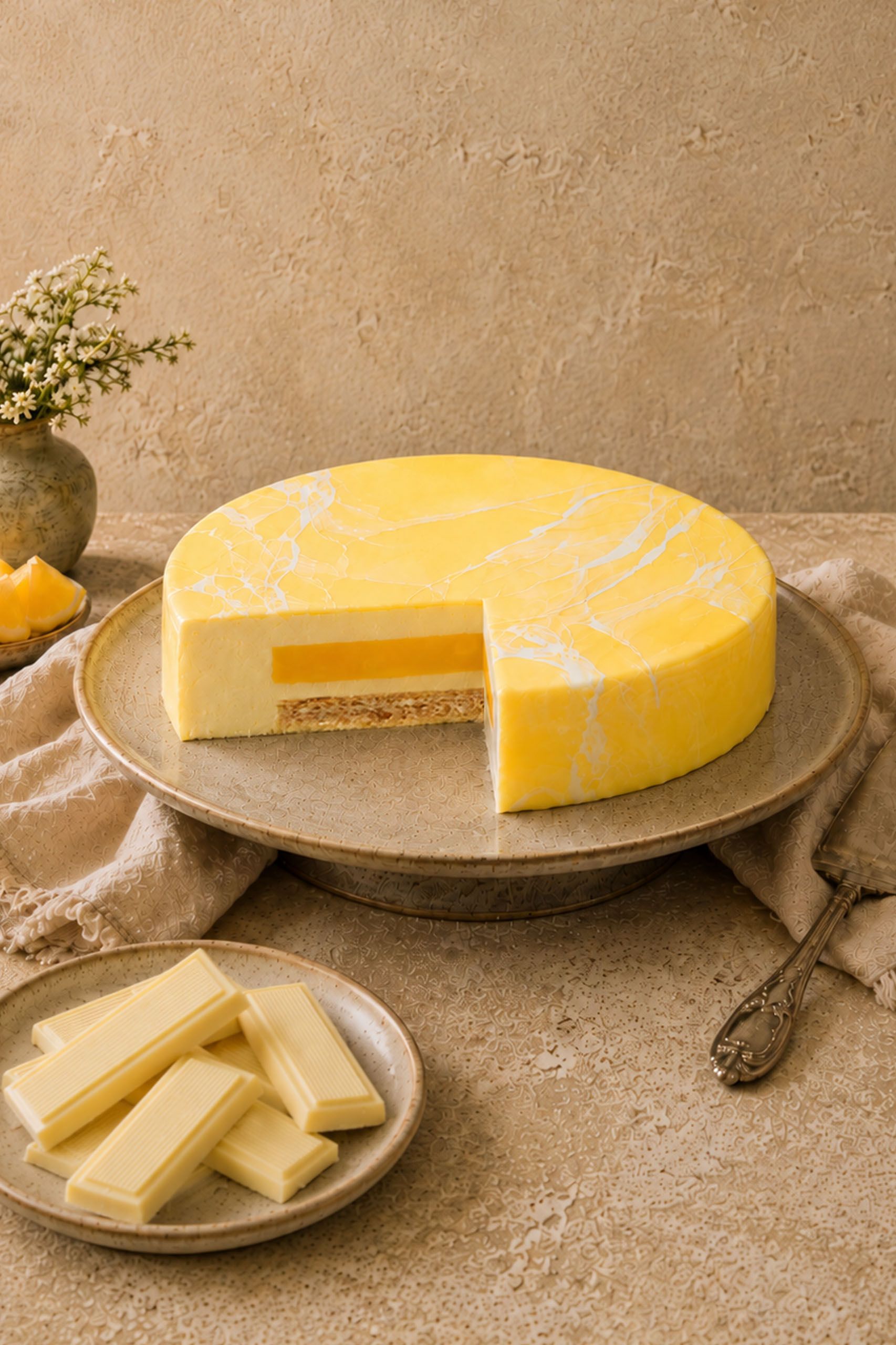
The cake is frozen at different stages of preparation and can remain frozen until 2 hours before serving.
Lemon curd
- Cover the base of two 16 cm rings with kitchen foil and place them on a flat tray that will fit in the freezer.
- Soak the gelatine in very cold water until softened.
- Process the sugar with the lemon zest.
- Place the egg yolks in a saucepan and whisk lightly. Add the sugar and whisk vigorously until pale. Gradually add the lemon juice and stir.
- Place the saucepan over a medium heat and cook, whisking continuously, until the first bubbles appear and the curd coats the back of a wooden spoon, about 20 minutes.
- Strain into another container and add the well-drained gelatine. Stir.
- Add the diced butter.
- Fill the rings and freeze.
Sponge
- Preheat the oven to 170°C with top and bottom heat and the fan on.
- Line two steel rings with baking parchment.
- Lightly whisk the eggs and sugar in a heatproof bowl. Set the bowl over a bain-marie, keep the heat low and whisk at high speed until the mixture reaches 40°C, about 8 minutes, or reaches the ribbon stage.
- Remove from the heat and whisk at low speed until cool.
- Sift the ground almonds and flour over the mixture and fold in gently with a spatula.
- Pour in the melted, cooled butter in a thin stream and fold it in with the final few strokes of the spatula.
- Pour the batter into the rings.
- Bake for about 18 minutes.
- Turn out and leave to cool.
- Remove a thin layer from the top or base, whichever is less browned, to obtain two 15 mm-thick discs.
Syrup
Place the ingredients in a saucepan and, once they come to the boil, cook for 8 minutes. Set aside at room temperature.
White chocolate mousse
- Cover the base of two 18 cm rings with kitchen foil and line the inside with an acetate strip of the same height. Place them on a flat tray that will fit in the freezer.
- Melt the chocolate in the microwave.
- Soak the gelatine in very cold water until softened.
- Whip the cream: for best results, make sure the cream and bowl are both cold. Whisk slowly at first to build volume, then increase the speed halfway through until soft peaks form. Refrigerate.
- Basic meringue: acidify the egg whites with a few drops of lemon juice. Whisk briefly at low speed to break them up, then gradually increase the speed. When the whites reach soft peaks but still move freely in the bowl, gradually add the sugar. Continue whisking at full speed until the meringue is creamy and glossy.
- Heat the yoghurt in the microwave.
- Add the well-drained gelatine to the yoghurt and stir with a silicone spatula until completely dissolved.
- Add the chocolate and stir.
- Gently fold in one quarter of the whipped cream. Pour this mixture over the remaining whipped cream and fold together.
- Fold in the meringue in the same way.
Assembling the cake
- Prepare the ring and pour in the mousse until it is almost half full.
- Remove the lemon curd disc from the ring and place it on top, carefully centring it and pressing it down slightly.
- Transfer some of the mousse to a piping bag.
- Fill the gaps around the disc and cover with another layer of mousse.
- Apply the syrup to the sponge using a squeeze bottle.
- Place it browned-side up and press down slightly.
- Add mousse to fill the gaps around the edges and spread a thin layer over the top so that the cake board will adhere.
- Place the cake board on top.
- Press down lightly and freeze on a sheet of baking parchment.
Glaze
- Soak the gelatine in very cold water, then dissolve it in 70 g very hot water.
- Place 100 g water, the glucose syrup and sugar in a saucepan. Heat over a medium heat until it reaches 103°C, about 15 minutes.
- Pour over the condensed milk. Stir.
- Add the white chocolate and stir until fully incorporated.
- Add the gelatine.
- Add a few drops of white food colouring.
- Place the hand-held blender at the bottom of the container and blend at the lowest speed, avoiding the formation of foam.
- Strain the mixture into two containers, about 380 g in each, and leave until it reaches 35°C, stirring occasionally to prevent a skin forming on the surface.
- Set aside a few spoonfuls of glaze and add a few drops of yellow food colouring. Pour the yellow glaze into the white glaze in a thin stream.
- Remove the cakes from the rings and place each one on a small ring on a cake turntable.
- Cover with the glaze, pouring it into the centre and turning the turntable to help it flow towards the edges.
- Leave to stand for a few minutes, bursting any bubbles that appear on the surface with a cocktail stick.
- Allow any excess glaze to drip off.
- Transfer the cakes to serving plates or return them to the freezer on baking parchment.
– Next time, I’ll try making this dessert with agar-agar because I suspect the texture will be more pleasant and less gelatinous.
Serve this cake very cold.